


Introduction:
I will review the article by Obed Appiah (myself) and Eva Billen (2024) on “Evaluating the Good Lives Model Among Students: The Role of Primary Goods and Self-Regulation in Achieving a Good Life” published in the Journal of Forensic Psychology Research and Practice. The Good Lives Model (GLM) was developed to guide prison services in reintegrating offenders into communities. The theory explains that there are important needs (called primary goods [PG]) in everyone’s life, that they pursue to elevate their psychological well-being. These include 11 needs (eg life, knowledge and friendship). The authors of the theory explain that people who strive to achieve a sufficient number of primary goods in a prosocial way are living a good life. People who cannot achieve the primary goods may resort to antisocial ways to elevate their psychological well-being. The model explains that offenders commit crimes because they have problems achieving certain Primary Goods (PG). The current study was therefore conducted to investigate two of these problems.
My Verdict
Purpose of the Study:
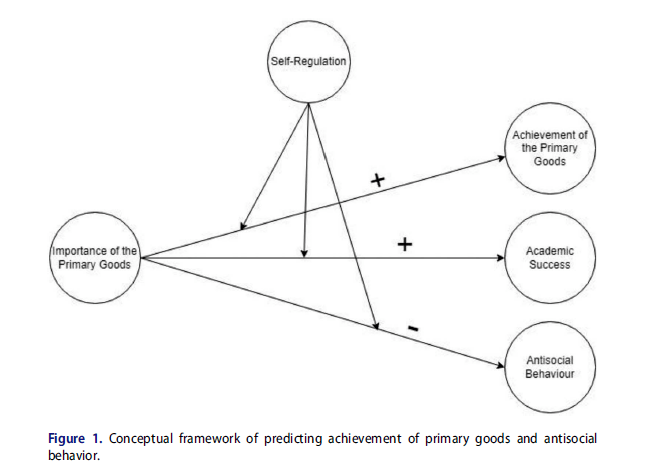
The study investigated how self-regulation (ability) affected the relationship between the importance of primary goods (motivation) and achievement of the primary goods and engagement in antisocial behaviour (see Figure 1). The authors predicted that self-regulation would have a positive effect on the relationship.
Method:
The authors recruited 156 students from universities in the Netherlands who filled out questionnaires about the importance of primary goods (people who find their primary goods important), self-regulation, achievements, and antisocial behaviour. Questionnaires were distributed through the University of Amsterdam lab website and on social media at a single point in time. Participants were at least 16 years old, understood English, and gave consent to the study.
Results:
I present the major findings of the study here.
- The study found that both conscientiousness and urgency (measures of self-regulation) had different effects on the relationship between the importance of primary goods and achievement of the primary goods and engagement in antisocial behaviour.
- Specifically, people who were more conscientious (people who plan and do it) and found their primary goods important were more likely to engage in less antisocial behaviour than those who indicated less importance of primary goods. However, as the level of conscientiousness reduced, the effect also reduced. These findings indicated that more self-regulation (conscientiousness) was good for people with a high importance of primary goods not to engage in antisocial behaviour.
- On the other hand, people who were more impulsive under emotionally charged situations (people with less self-control when they are very sad or happy) and had high importance of primary goods were more likely to get higher GPAs and engage in less antisocial behaviour than people with lower levels of importance of primary goods. However, people who were less impulsive under emotionally charged situations and had more importance of primary goods were more likely to get lower GPAs and engage in more antisocial behaviour than people with lower levels of importance of primary goods. These findings were contrary to expectations as they indicated that more self-regulation (lack of urgency) was not good for the relationship between the importance of primary goods and achievement of their primary goods and engagement in antisocial behaviour.
- Other direct associations were that more importance of primary goods and more conscientiousness were associated with higher achievement of the primary goods. Also, high importance of the primary goods was associated with a high GPA. However, more impulsivity under emotionally charged situations was associated with more achievement of the primary goods.
My take
Implication:
The following should be viewed in light of the sample that was studied, i.e. general population (students).
- The study shows that having important primary goods and being able to plan and do them helped people achieve their goals and engage in less antisocial behaviour. This means that having the desire to do good must go with the ability to carry it out.
- The results on impulsivity also suggest that boldness (not restricting oneself) can be good for achieving one’s goals. It further revealed that less restriction of one’s behaviour under emotional situations helped people who found their primary goods important to engage less in antisocial behaviour. This means that boldness helps people achieve their goals and engage in less antisocial behaviour.
Strength:
The study was the first to investigate how self-regulation affected the relationship between having important primary goods and achieving them and engaging in antisocial behaviour. This helps in expanding the Good Lives Model. The authors made suggestions, such as developing standards, to improve the investigation of the model.
Limitation:
The use of the correctional method made it difficult for the authors to determine whether one variable caused the other. For example, whether having important goals leads to achieving it or whether achieving ones goals leads to seeing the goal as important. Future studies could utilize longitudinal and experimental designs to better understand the causal relationship between the variables. This will enable counselors to provide more effective advice to their clients.
Using a student sample from the Netherlands makes it difficult for the authors to generalize their findings to other cultures such as an African population. Also, the use of students makes it difficult to generalize the findings to another context such as a clinical or criminal context. Other researchers should investigate these effects in various samples to help in the generalization of the findings.
My proposal:
The finding on the effect of urgency on the relationship between the importance of the primary goods and achievement of the primary goods and engagement in antisocial behaviour was contrary to the expectations of the authors. More research should be done on this relationship to help clarify the surprising finding.
My Experience with the Project:
I conducted this research with Dr. Eva Billen at the University of Amsterdam. I have dedicated a blog post (click here) to discuss my motivation and experience on the project. You can read it for inspiration for your own project.
Original paper citation:
Appiah, O. K., & Billen, E. (2024). Evaluating the Good Lives Model Among Students: The Role of Primary Goods and Self-Regulation in Achieving a Good Life. Journal of Forensic Psychology Research and Practice. https://doi.org/10.1080/24732850.2024.2394528
Other references:
Ward, T., & Fortune, C.-A. (2013). The good lives Model: Aligning risk reduction with 840 promoting offenders’ personal goals. European Journal of Probation, 5(2), 29–46. https://doi.org/10.1177/206622031300500203
Ward, T., & Gannon, T. A. (2006). Rehabilitation, etiology, and self-regulation: The comprehensive good lives model of treatment for sexual offenders. Aggression & Violent Behavior, 11(1), 77–94. https://doi.org/10.1016/j.avb.2005.06.001845
Ward, T., Mann, R. E., & Gannon, T. A. (2007). The good lives model of offender rehabilitation: Clinical implications. Aggression & Violent Behavior, 12(1), 87–107. https://doi.org/10.1016/j.avb.2006.03.004
 oak27oak
2 Replies to “Article Review: Evaluating the Good Lives Model Among Students…”