


Introduction
I will review the study by Merrin et al. (2019) on Developmental changes in deviant and violent behaviors from early to late adolescence: Associations with parental monitoring and peer deviance. Parental monitoring is the extent to which parents are aware of the whereabouts and activities of their children. To be aware of their children’s activities, parents can ask their children or the child themselves voluntarily disclose information. Peer deviance on the other hand is the extent to which the child associate with friends who engage in negative behaviours such as stealing and fighting.
Researchers have found that high parental monitoring is associated with low engagement in deviant and violent behaviours. Also, studies have found that youth who associate with more deviant peers are more likely to engage in deviant and violent behaviours than youth who associate with fewer deviant peers. Most studies that have investigated the association between these variables, compared how individuals deviate from a grand mean (between-person approach). That is comparing one person with another, for example comparing children of parents with parental monitoring with children of parents with low parental monitoring. However, it will be more interesting for studies to investigate these associations by comparing individuals with themselves (within-person approach). That is, if a parent changes the degree they monitor their child, is it associated with a change in their child’s behaviour over time?
My Verdict
Purpose of the Study:
The study investigated whether:
- The within- and between-person association between parental monitoring and peer deviance on adolescent deviant and violent behaviours.
- The relationship between peer deviance and adolescents’ deviant and violent behaviours depended on parental monitoring.
Method:
- Accelerated longitudinal growth: In this method, the authors recruited 1,162 students from grades 5, 6, and 7 (10-11, 11-12, and 12-13 years) and study them over 5 years. The authors took measurements in six waves (that is six times across the 5 years). There were 6 months in between waves. The method allowed the authors to treat their data as if they studied only one cohort group over 10 waves.
- Self-report of variables: Participants from 4 Midwestern middle schools (USA) filled out questionnaires about their deviant and violent behaviours, perceived parental monitoring, and their association with delinquent peers.
- The data were analyzed using Multilevel growth curve models. This method allows researchers to observe changes in variables over time. Level 1 of the data takes into consideration that participants provided 6-time points of information. Therefore, variables were person-mean-centred which carried within-person information. Level 2 compares one participant with another participant. Therefore, variables were grand-mean-centred which carried between-person information.
Results:
The direct effect of Parental Monitoring
Within-person: Increase in parental monitoring at a one-time point was associated with a decrease in deviant and violent behaviours at the same time point.
Between person: Compared with adolescents who reported low parental monitoring, adolescents who reported high parental monitoring reported engaging in less deviant and violent behaviours over time.
The direct effect of Peer Deviance
Within-person: Associating more with deviant peers at a one-time point was associated with a decrease in deviant and violent behaviours at the same time point.
Between person: Compared with adolescents who reported low association with deviant peers, adolescents who reported associating more with deviant peers also reported engaging in more deviant and violent behaviours over time.
Moderating effect of parental monitoring:
(I report only between-person parental monitoring and between-person peer deviance interactions, however, the authors also investigated cross-level within-person parental monitoring and between-person peer deviance interactions)
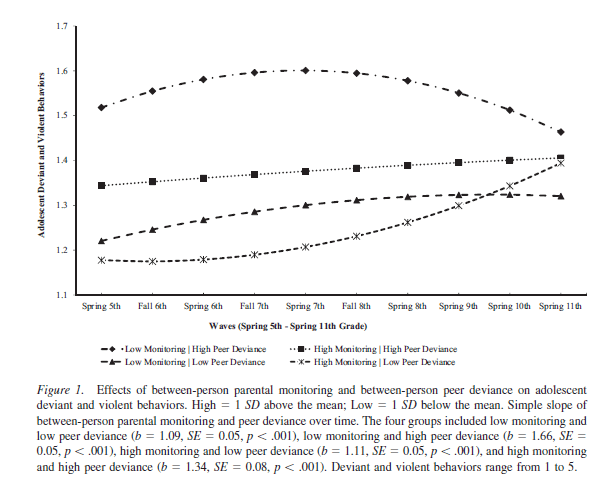
Adolescents that indicated both high parental monitoring and peer deviance association also reported a lower rate of increase in deviant and violent behaviour compared with adolescents that indicated low parental monitoring and high peer deviance association over time. Also, adolescents that indicated both low parental monitoring and peer deviance association reported the second lowest initial rates of deviant and violent behaviour, whereas adolescents that indicated high parental monitoring and low peer deviance association had the lowest initial rates of deviant and violent behaviours, however, they started to increase over time, see Figure 1.
My take
Implication:
The results suggest that adolescents who associate with deviant peers also engage in more deviant and violent behaviours. Therefore, parents can utilize strategies that help reduce their children’s engagement with deviant peers to reduce negative behaviour. Also, monitoring the activities of adolescents helps reduce their engagement in deviant and violent behaviours. The results further suggest that parental monitoring was beneficial to reduce violent behaviour for adolescents that associated with more deviant peers than adolescents who were not monitored. With this said, caution should be taken by parents with adolescents that engaged with less deviant peers. This is because such adolescents may interpret the monitoring by their parents as invasive and start to engage in deviant behaviour. Parents should therefore be tactful with their monitoring.
Strength:
- The use of accelerated longitudinal growth helped in several ways: It helps save time and cost, that is, instead of following participants over 10 waves, the authors followed them for 6 waves and at the same time treated the data as if participants were studied over 10 waves. Also, it helps reduce the rate of losing participants over time. For instance, the rate of attrition over 6 waves is better than the rate of attrition over 10 waves.
- The authors distinguished within- and between-person effects. This helps overcome the challenge of alternative explanations when only one of the approaches is used.
Limitation:
- The use of self-report is subjected to a lot of bias such as social desirability. This means that adolescents may underestimate their engagement with deviant peers and engagement in deviant and violent behaviour. Future research should include parental and teacher measures as well.
- Even though the longitudinal approach is the initial approach to studying whether one variable causes another, however, the analysis approach prevents us from making such causal interpretations for several reasons: The authors looked at only contemporaneous effects of the predictors on the outcome variables. That is the effect of parental monitoring on deviant behaviour at the same time point. It would have been better to look at the cross-lagged effect, that is the effect of parental monitoring at wave 1 on deviant behaviour at wave 2. Also, the current approach assumes a unidirectional effect, for example, deviant peer association causes adolescent deviant behaviour. However, it may also be that deviant adolescents choose deviant peers. A better way of analysing the data should have been investigating the bidirectional associations. That is, how deviant peer causes deviant behaviour and how deviant behaviour leads to deviant peer association. This would have given a clear sense of the direction of the association. The authors should have therefore used a random intercept cross-lagged panel model (RI-CLPM) or other methods that allow them to isolate within and between-person factors, at the same time access cross-lagged effects and bidirectional relationships.
My conclusion:
The current study overcome the challenge of previous studies that only used between-person effects. However, it does not allow researchers and practitioners to make any causal inferences because of how the data was analysed. I have therefore suggested a different way of analysing the data that provide evidence for one of the basic requirements of establishing a causal relationship, that is sequential ordering of variables.
Original paper citation:
Merrin, G. J., Davis, J. P., Berry, D., & Espelage, D. L. (2019). Developmental changes in deviant and violent behaviors from early to late adolescence: Associations with parental monitoring and peer deviance. Psychology of violence, 9(2), 196.
 oak27oak