


Introduction
I will review the study by Hoogeveen et al. (2022) on A many-analysts approach to the relation between religiosity and well-being. Many people have questioned the utility of religion in modern times. However, research has shown that religion may have benefits for the mental well-being of the individual. Regardless of these results, the debate about the benefit of religion on mental health still lingers. Some scholars have questioned the methods of these research papers, others have also alleged that researchers’ interest may bias results (i.e. believers want to produce a positive result while skeptics want to produce a negative result), and lastly, some have attributed the benefit to the perceived cultural norms regarding religion. The last point suggests that people may benefit from religion when they find themselves in an environment where religion is valued.
My Verdict
Purpose of the Study:
The study investigates whether:
- Religious people self-report greater well-being.
- The relationship between religiosity and self-reported well-being depends on perceived cultural norms regarding religion.
Method:
- Cross-sectional data: 10,535 participants from 24 countries filled out questionnaires at one time about their religiosity, subjective well-being, and other demographic information. Participants were 18 years and above.
- The data was analyzed using a many-analysts approach: 120 teams of researchers analyzed the data. These researchers were from different fields of study including the psychology of religion, social psychology, and others. The team size ranged from 1 to 7 researchers with a median of 2 researchers. Each team included at least a PhD candidate or a more senior researcher. The teams had the freedom to choose which analytic method, and specific items for the independent and dependent variables, and covariates to include in their analysis.
- Blind data: Some research teams received a blinded version of the data to make their analytic plan and preregister it before they received the actual data. Teams were to report whether they made any changes to their analysis after they saw the data.
Results:
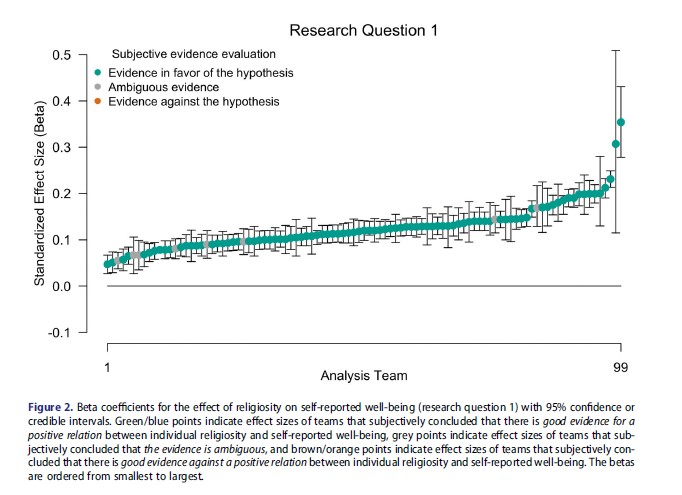
- Research Question 1: All 99 of the beta coefficients provided by the 120 teams were positive beta values whose 95% confidence/credible interval excluded zero. The researchers could not calculate the beta values of 21 teams because of the method they used, of which 3 of the teams reported evidence against the prediction. This means that all but 3 teams provided results that supported the prediction that “Religious people would self-report higher well-being”. See the results in Figure 2 adopted from the original article below.
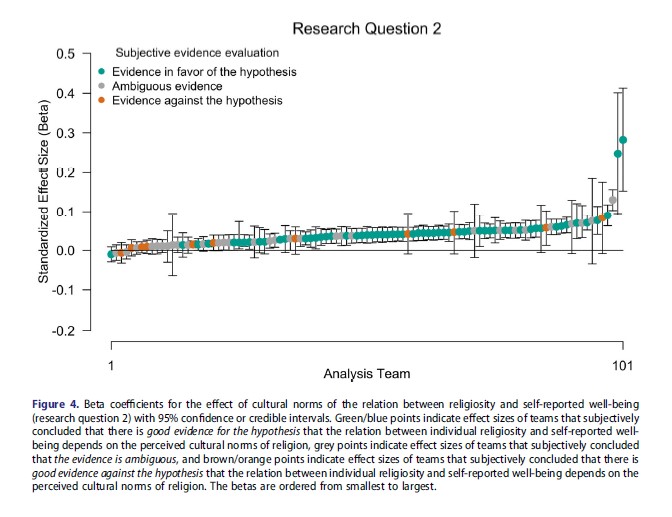
- Research Question 2: Out of the 101 beta values extracted from the 120 teams, 97 of the beta values were positive, and 66 of the positive values had a beta value whose 95% confidence/credible interval excluded zero. This means that many of the results supported the prediction that “the relationship between religiosity and self-reported well-being depends on perceived cultural norms regarding religion.” See the results in Figure 4 adopted from the original article below.
My take
Implication:
The results suggest that religion has a positive effect on the subjective well-being of the person. The benefit of religion may be attributed but not limited to the following: religion provides a social environment where individuals can receive social support; religion provides a way through which individuals may interpret life events that may prevent psychopathology; and lastly religion provides people with a sense of meaning for their lives. However, the results of the second research question suggest that the environment in which a person finds themselves may affect the benefit. Even though the current study does not investigate this more, it may be that religious people who find themselves in a supportive environment benefit more, while those who find themselves in a hostile environment may benefit less or not benefit at all. Researchers should conduct further research to unravel this.
Strength:
- The use of a many-analysts in analyzing the data provides robust results compared with previous studies. Researchers in the current study had different interests and the results cannot be attributed to a single choice of statistical plan or a particular interest of a specific researcher. Getting consistent results from almost all of the 120 teams provides the support that the effect of investigation exists.
- The teams also had a choice to include covariates such as socioeconomic status, age, GDP, and sample type (whether general public or student samples). This helps eliminate alternative explanations for the effect of interest.
- The sample size is large enough and data from 24 countries allows the researchers to generalize their findings to different populations and cultures.
Limitation:
- The use of self-report is subjected to a lot of bias such as social desirability. This means that religious people might have overestimated their subjective well-being because society expects them to act happy. Future research should include other objective measures.
- Cross-sectional data may not provide us with the full picture. It would have been appropriate to use longitudinal data to capture the stable and dynamic characteristics of the variables and their association. Also, we cannot establish any causal relation, such as “religion causes happiness”, it is equally probable that “happy people are more likely to choose a religion”. As it stands in the current analysis, we cannot make a causal attribution. We need longitudinal data to investigate such claims.
My conclusion:
The current study compared with previous studies provides stronger evidence for the positive effect of religion on subjective well-being. These results can be generalized to other adult populations. However, more studies are needed to investigate the causality of religion on well-being and unravel the moderating effect of perceived cultural norms regarding religion on the relationship.
My Experience with the Project:
I am one of the authors of the study. I got interested in the project because of my religious belief and interest in science. In my team, I was the only Christian. I learned more about cooperation as a researcher and tolerating opposing views. I also was introduced to new ways of analyzing data. Before my involvement in the project, I only knew about correlation, t-tests, and ANOVA. However, the project ignited my interest in learning new methods such as regression, structural equation modeling (SEM), and meta-analytic SEM (MASEM). I look forward to joining such other projects to broaden my understanding of the research field.
Original paper citation:
Hoogeveen, S., Sarafoglou, A., Aczel, B., Aditya, Y., Alayan, A. J., Allen, P. J., Alzahawi, S., Amir, Y., Anthony, F.-V., Appiah, O. K., … & Wagenmakers, E. -J. (2022). A many-analysts approach to the relation between religiosity and well-being. Religion, Brain & Behavior, 1-47. https://doi.org/10.1080/2153599X.2022.2070255
 oak27oak