


Over the years, many societies have used religion to suppress the activities of women. This cuts across the major religions in the world. I am sad that some Christian sects also propagate some of these ideas. This write-up will focus on what the Bible says about the role of women in the world, and the Church of God. I seek to debunk two major ideas that some people have propagated over the years. I will be analysing the biblical basis upon which people defend such ideas. The two ideas are “God created women as an afterthought” and the second is “women are not supposed to preach in the Church.”
God Created Women as an Afterthought

Some people hold the idea that women were not part of the initial creation of God but rather God created them later as an afterthought. According to those people, God created man first. After he saw that man was lonely then he created the woman. According to them, this shows that women were not part of the initial plan of God. Now let us see what the Bible says about this.
Then God said, “Let us make man in our image, after our likeness. And let them have dominion over the fish of the sea and over the birds of the heavens and over the livestock and over all the earth and over every creeping thing that creeps on the earth.” So, God created man in his own image, in the image of God he created him; male and female he created them.
Genesis 1:26-27
Watch the verse closely, it uses certain words and pronouns which connotes that the verse is referring to two people. It begins with “let us make man”. The Hebrew word used for man is Adam. Some may argue that God was referring to the first man, “Adam”. This idea is not obvious from the verse because, in other parts of the Bible, the word “Adam” is translated as “human”. If you go on with that verse (Genesis 1:28-27), the second part of it says “and let them”. This brings out the idea that God was referring to more than one person. Someone will argue that “okay, God was referring to men, as in only the male gender”. The response to this is that the word “them” does not explicitly describe any gender. It may only describe males if the initial noun in that verse was describing only males. What I want you to take note of here is that the verse uses them (plural) not him (singular). The last part of that scripture brings out the point I am trying to make. It says “in the image of God he created him; male and female he created them.” (Emphasis mine). We see explicitly that there is a mention of “male and female he created them”. This reveals that God’s initial plan of creating humans also included women. Women are equally the image of God as noted above – “in the image of God he created him; male and female he created them”. Someone will question, “ok in Genesis 2:7 we see God create man first and he thought of creating the woman later in Genesis 2:18-19, which makes it an afterthought”. When we read the scriptures, in Genesis 2:7, the Hebrew word used for creating man was “wayyiser”, which means “formed”. The word “wayyiser” is also used throughout Genesis chapter one for the creation of all other things, so it expresses the idea of “bringing something which was not existing into being”. On the other hand, the word used for the creation of woman in Genesis 2:18-19 was “wayyiben”, which means “fashioned or made”. In other parts of the Bible, like when Noah was building the ark, the word “wayyiben” was translated as “built”. “Wayyiben” expresses the idea of “developing or building upon something which already exists”. So, with the two scriptures above, God first formed the physical frame of a male and he had to pull the female body out of that same frame he formed. If the creation of the woman was an afterthought, then God would have formed the woman separately from the man. On the contrary, the Genesis record shows that God knew where he could get the woman and he did not need to create a new body. This shows that the woman was already present. All that God had to do was to pull her out of the man. That is why the first scripture that talks about the creation of humans says “So God created man in his own image, in the image of God he created him; male and female he created them“. This means that, when God said he was creating humans, He included both sexes, male and female. The creation of the woman was part of God’s plan and not an afterthought. Let us now address the second issue about the work of women in the Church.
Women Should not be Revered Ministers or Preachers in the Church

For generations, some Christian sects do not allow women to be revered ministers. They usually defend this decision by using two scriptures. These scriptures are:
A woman should learn in quietness and full submission. I do not permit a woman to teach or to assume authority over a man; she must be quiet.
1 Timothy 2: 11-12
Women should remain silent in the churches. They are not allowed to speak but must be in submission, as the law says. If they want to inquire about something, they should ask their husbands at home; for it is disgraceful for a woman to speak in the church.
1 Corinthians 14:34-35
These two scriptures have been under intense debate. The debate centres on how we are supposed to interpret them. One interpretation that provides support for women to work in the church is that Paul gave these instructions as a direction to govern the local church (the church at Corinth) and he gave that instruction because of the situations of the women at that time. Proponents of this view say that it was a unique situation and does not apply to the universal Church.
I do not seek to do a reinterpretation of those verses but I would like to draw from instances in the New Testament Church where women worked in Church, to support the idea that the Church should allow women to preach and hold positions in the church. I will start by arguing about the purpose of the gifts and offices that God has established in the church.
The Day of Pentecost
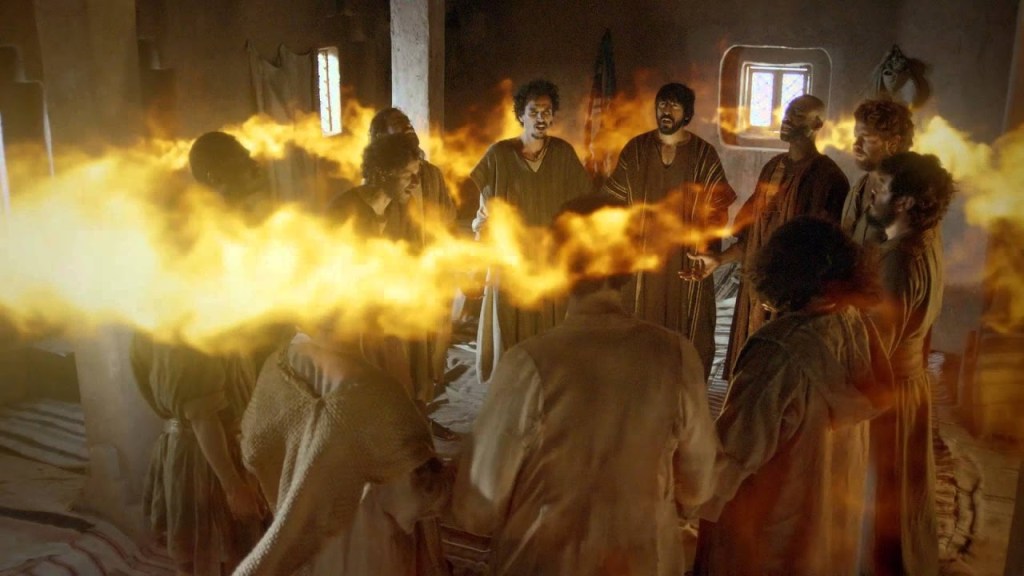
The coming of the Holy Spirit was on the day of Pentecost. On that day, the disciples had gathered to pray and suddenly the Holy Spirit filled the room. Everyone in the room started to speak in tongues (Glossolalia). Some people who were outside and observing the disciples started mocking them because those people could not understand what the disciples were saying. Peter, one of the disciples, stood and quoted from the Old Testament to defend their actions. That scripture gives us the idea about the person who can receive the gift of God.
This is what Peter quoted from the prophet Joel:
In the last days, God says,
Acts 2:17-18 (Emphasis mine)
I will pour out my Spirit on all people.
Your sons and daughters will prophesy,
your young men will see visions,
your old men will dream dreams.
Even on my servants, both men and women,
I will pour out my Spirit in those days,
and they will prophesy…”
From the scripture above, it says “I will pour my spirit on all people”. Other versions translate all people as “all flesh”. Which mean any human being, regardless of their gender, can receive the Spirit of God. It goes on to say “Your sons and daughters will prophesy”, this means the work of prophecy is not limited to a particular gender. So, inherently if anyone has the gift of prophecy, the church should allow the person to exercise it. The verse goes on to say “Even on my servants, both men and women,”. Someone will then question that, “but that scripture only talks about prophecy, so it doesn’t apply to other gifts”. My response will be that the scripture used prophesying as an illustration of the manifestation of the Holy Spirit. Even without talking about prophecy, what we should understand from this scripture is that women can also receive the Spirit of God.
Works of Women in the Church
The next line of support for women to preach in the Church is that the Church allowed women to work in the Church in the first century. Let us look at how Paul acknowledged the works of women in the Churches. In his letter to the Romans, this is what Paul wrote,
I commend to you our sister Phoebe, a deacon of the church in Cenchreae. I ask you to receive her in the Lord in a way worthy of his people and to give her any help she may need from you, for she has been the benefactor of many people, including me. Greet Priscilla and Aquila, my co-workers in Christ Jesus. They risked their lives for me. Not only I but all the churches of the Gentiles are grateful to them. Greet also the church that meets at their house… Greet Tryphena and Tryphosa, those women who work hard in the Lord. Greet my dear friend Persis, another woman who has worked very hard in the Lord.
Romans 16:1-5, 12
From the above scripture, Paul acknowledged the works of several women. These names are just a sample of them. One of the women that stands out is Phoebe who Paul said held the position of a deacon. Someone may argue that “Paul is just mentioning the names of these women but he is not telling them to teach in the church or do something”. In the first place, that argument cannot stand because in the scripture Paul was acknowledging their hard work. To answer the substance of the enquiry, we will look at specific instances in the New Testament Church where women taught. One of them is Priscilla who was the wife of Aquila (from the verse above).
Meanwhile a Jew named Apollos, a native of Alexandria, came to Ephesus. He was a learned man, with a thorough knowledge of the Scriptures. He had been instructed in the way of the Lord, and he spoke with great fervor and taught about Jesus accurately, though he knew only the baptism of John. He began to speak boldly in the synagogue. When Priscilla and Aquila heard him, they invited him to their home and explained to him the way of God more adequately.
Acts 18:24-26
Over here, the Bible makes mention of the role both Priscilla and Aquila played in explaining the word of God to Apollos. This shows that Priscilla was competent enough to instruct a man (Apollos), who was doing the work of God.
Also, let us look at the people who trained Timothy. Paul in his letter to Timothy acknowledged the role Lois and Eunice played in the life of Timothy.
I am reminded of your sincere faith, which first lived in your grandmother Lois and in your mother Eunice and, I am persuaded, now lives in you also.
2 Timothy 1:5
“But as for you, continue in what you have learned and have become convinced of, because you know those from whom you learned it, and how from infancy you have known the Holy Scriptures, which are able to make you wise for salvation through faith in Christ Jesus.”
2 Timothy 3:14-15
In these scriptures, Paul acknowledged what these two women taught the young Timothy. He encouraged Timothy to trust the lessons and hold on to them.
Also in Acts 21:9, Luke recorded the account of four daughters of Philip who prophesied. John in his third book (2 John 1:1,5), makes mention of a Lady. This shows that the instructions of that book were for the Lady to carry them out. Also, when we investigate the Gospels (Matthew, Mark, Luke, and John), we see various roles that women played in the ministry of Jesus including proclaiming the resurrection of Jesus Christ to the Apostles (John 20:18). We can also identify several instances women worked in the New Testament. All these prove that the New Testament church did not prohibit the work of women in the first century.
From the above discussions, the New Testament church never placed any form of limitations on the role women played in the church so why should the church do it now? The role women play in the church is as important as that of men and we should encourage it. God has poured His Spirit on all flesh and we should encourage anyone who wants to take up those roles, there should not be any systemic hindrances.
Photo credit
- Most of the free pictures are from Pexels.com
- The Day of Pentecost – YouTube
appreciation
I would like to express my profound gratitude to Onyina Andrews Frimpong for taking the time to help in the proofreading of the manuscript of this write-up and making important additions. I say God richly bless and increase him. I do however take responsibility for any typographical errors, omissions, and grammatical mistakes in this document.
 oak27oak