


Baptism is one of the Christian practices which is performed by most of the Christian denominations. This practice is an instruction directed by the Lord Jesus as his last command to his disciples before he left the earth.
And Jesus came and spoke to them, saying, “All authority has been given to Me in heaven and on earth. “Go therefore and make disciples of all the nations, baptizing them in the name of the Father and of the Son and of the Holy Spirit, “teaching them to observe all things that I have commanded you; and lo, I am with you always, even to the end of the age.” Amen.
Mathew 28:18-20, Emphasis Mine.
This seems to be a clear and direct command given by the Lord, but over the years, a lot of Christian denominations seem to disagree on a lot of things about the baptism which seems to cause a lot of confusions in the minds of young Christians. In this write-up, I seek to answer some questions concerning baptism and salvation, more specifically “what happens to a person who accepts Christ as Lord and personal saviour but is not able to undergo baptism?” and also “what method of baptism is good or acceptable by the Lord?” I conclude by looking intensively at the true meaning of baptism and its purpose.
BAPTISM AND SALVATION

As already noted, the instruction to baptise was given by the Lord himself, and the Lord himself underwent the practice. A lot of Christians see this ritual as a rite of initiation to introduce the young Christian into Christianity. With this, it gives the young Christian the opportunity to publicly profess his faith for all to see and his commitment to walk the new life, as the Lord himself said:
“Therefore whoever confesses Me before men, him I will also confess before My Father who is in heaven. But whoever denies Me before men, him I will also deny before My Father who is in heaven.”
Matthew 10:32-33.
Someone will then ask, if baptism is that important, what happens if one is not able to undergo such a practice? Some Christian denominations in their teaching points out that anyone who does not undergo baptism will not enter heaven since baptism is tied to the very essence of our salvation. Is this assertion really true? To answer this, let us first look at some practical reasons which may prevent a person from being baptised;
- The world recently has been hit by several epidemics and pandemics, two of them which have greatly prevented people from having contacts with each other are Ebola and COVID19. To reduce the spread of these diseases, a lot of governments have placed restrictions on social interactions which may greatly affect the practice of baptism.
- Some church denominations organise special baptism services once in a year, which means until such a time of the year, such a person may not have an opportunity to be baptised.
- Some people get to hear the gospel and accept Christ as their Lord and Saviour on their dying bed making it impossible for them to get baptised.
The question then is, what happens to a person who gives his life to Christ and dies before he gets the opportunity to be baptised? A classical response to this question is the man on the cross the day Jesus was crucified (Like 23:39-43). When the man acknowledged and asked for a pardon from the Lord, it was practically impossible for such to be baptised but the words of the Lord was so soothing and I believe the Lord responds similarly to everyone who believes in him and it’s not possible for the person to be baptised;
Then he said to Jesus, “Lord, remember me when You come into Your kingdom.” And Jesus said to him, “Assuredly, I say to you, today you will be with Me in Paradise.”
Luke 23:42-43.
The condition for salvation is quite clear and stipulated in several verses of the scriptures;
For God so loved the world that He gave His only begotten Son, that whoever believes in Him should not perish but have everlasting life… He who believes in Him is not condemned; but he who does not believe is condemned already, because he has not believed in the name of the only begotten Son of God.
John 3:16,18, Emphasis Mine.
But what does it (the scriptures) say? “The word is near you, in your mouth and in your heart” (that is, the word of faith which we preach): that if you confess with your mouth the Lord Jesus and believe in your heart that God has raised Him from the dead, you will be saved. For with the heart one believes unto righteousness, and with the mouth confession is made unto salvation.
Romans 10:8-10, Emphasis and First Bracket Mine.
Believing in the Lord Jesus is the path to salvation, as the person is added to the family then the others such as baptism will follow. When you follow the order of the Lord’s command in Mathew 28:18-20 he first say “Go therefore and make disciples of all the nations”, by this he is implying that, first make them believe which is the utmost important thing (1 Corinthians 15:1-3) after that “baptizing them in the name of the Father and of the Son and of the Holy Spirit.” A person must become a citizen of a country first before he can enjoy certain rights such as acquiring a passport. It is not the other way round.
Then someone will ask, if it’s possible for us to be saved without baptism, why be baptised? The answer is quite clear in the last command of the Lord as quoted earlier in Mathew 28:18-20, when we get baptised, we fulfill the command of the Lord. And as we will see shortly, the meaning of baptism encapsulates the idea of salvation. This brings us to the next question “which method of baptism is to be preferred?”
PREFERRED METHOD OF BAPTISM.
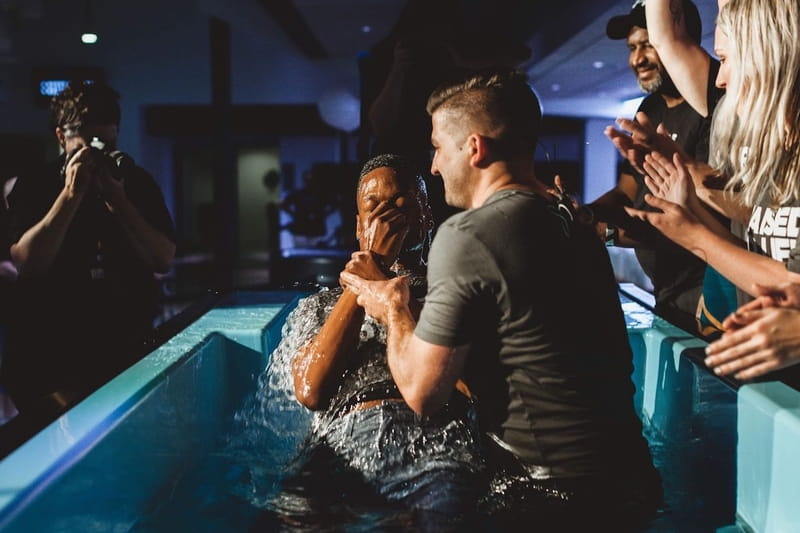
I have observed with keen interest over the years how some Christian denominations emphasise baptism by immersion while some even emphasise the fact that it has to be done in a river and that all other methods are wrong. Does the method of baptism matter? Now why do we baptise? We baptise because it was a command that Jesus gave the disciples before ascending;
“All authority in heaven and on earth has been given to me. Therefore go and make disciples of all nations, baptizing them in the name of the Father and of the Son and of the Holy Spirit, and teaching them to obey everything I have commanded you. And surely I am with you always, to the very end of the age.”
Matthew 28:18-20, Emphasis Mine.
Now take note, the verse above only tells us to baptise but not how to baptise, or what to baptise with. It says “baptizing them” not “baptizing them with water” or “baptizing them in a river”. Even earlier in the life of Jesus, this is what John the Baptist had to say about the baptism that Jesus was bringing;
“I [John the Baptist] baptize you with water for repentance. But after me will come one who is more powerful than I [Jesus], whose sandals I am not fit to carry. He [Jesus] will baptize you with the Holy Spirit and with fire …”
Matthew 3:11-12, Emphasis and Bracket Mine.
Clearly John even makes it clear that the baptism was not something to do with water but a spiritual one. The reason why most emphasise the baptism in river is that Jesus was baptised in the River Jordan (Matthew 3:13, Mark 1: 9);
“As soon as Jesus was baptized, he went up out of the water. At that moment heaven was opened, and he saw the Spirit of God descending like a dove and lighting on him.”
Matthew 3:16, Emphasis Mine.
Now from the above, the only image and detail we get about the baptism is that “he went up out of the water”, as to whether he was submerged in the water or not, take note, the verse was silent about of it. Now some interpret “he went up out of the water” as someone being submerged in water and coming up, but it can also create an impression of someone who walks into a river and walks out of it.
Now others also emphasise submerging into a river from the translation of the word baptism which in Greek is “baptizo” which means to immerse or to dip or submerge. Now let us take a look at an instance in the bible where the word was used without even water touching anyone.
“For I do not want you to be ignorant of the fact, brothers and sisters, that our ancestors were all under the cloud and that they all passed through the sea. They were all baptized into Moses in the cloud and in the sea.”
1 Corinthians 10:2, Emphasis Mine.
To understand this scripture well let make reference to some Old Testament texts. This was a time the Israelites were crossing the Red Sea, the Bible record shows that not even did they walk in the water but on dry ground;
“Then the Lord said to Moses, “Why are you crying out to me? Tell the Israelites to move on. Raise your staff and stretch out your hand over the sea to divide the water so that the Israelites can go through the sea on dry ground… Then Moses stretched out his hand over the sea, and all that night the Lord drove the sea back with a strong east wind and turned it into dry land. The waters were divided, and the Israelites went through the sea on dry ground, with a wall of water on their right and on their left.”
Exodus 14:15-16,21-22, Emphasis Mine.
Comparing the 1 Corinthian verse with the Exodus record shows that the Israelites being baptized unto Moses was without water touching them. This shows that baptism goes deeper than just the immersion of people into water. Anytime people emphasise method over principles, we lose focus of why something was established most of the time. Let’s take a look at such an instance. When the Israelites were in the wilderness and needed water, God gave Moses instruction to hit the rock for water to come out, he did and water came out (Exodus 17:1-7). At another time the Israelites were again thirsty and God told Moses to take his staff and speak to the rock for water to come out, but because of anger, Moses hit the rock (Numbers 20:1-13). Yes, water came out but God was angry with him because he didn’t follow his instruction. The same method used at different times, produced the same results but different reactions, the second instance invoked the anger of God. He wanted to teach Moses obedience but he did otherwise. This should let us know that we shouldn’t stress method over purpose.
To hold onto a method and lose sight over the purpose is very dangerous. I have heard people talking severally about how a particular method of baptism is right over another, others go to the extent of re-baptising the individual (I call it double baptism) all because the baptism was not done in that particular church and to make sure it was done properly, they baptise the person again. Paul baptising some people again in the New Testament was not because the method was wrong but rather the people were not baptised in the name “of the Father and of the Son and of the Holy Spirit” (Acts 19:1-5) as instructed by the Lord in Mathew 28:18-20. You always hear people talk about the method of baptism not being right but I am yet to hear people also talk about the purpose for the baptism. You may be baptised right (as to which method is right, I am yet to know) but if the effect of the baptism does not reflect on your life, such a practice becomes merely a bodily ritual.
Let us liken baptism to circumcision in Judaism, as Paul said “For he is not a Jew who is one outwardly, nor is circumcision that which is outward in the flesh; but he is a Jew who is one inwardly; and circumcision is that of the heart, in the Spirit, not in the letter; whose praise is not from men but from God.” (Romans 2:28-29). Now let’s apply this verse into the Christian context by replacing Jew with ‘Christian’ and circumcision with ‘Baptism’, now let’s read the verse as “For he is not a Christian who is one outwardly, nor is baptism that which is outward in the flesh (by merely submerging someone into water); but he is a Christian who is one inwardly; and baptism is that of the heart, in the Spirit, not in the letter; whose praise is not from men but from God.” With this said, let’s now look at the purpose of baptism and we will see why we should emphasise that over the method of baptism.
MEANING AND PURPOSE OF BAPTISM.

Now the Apostle Paul clearly lets us understand the meaning and the purpose of baptism when he wrote to the Romans in Romans 6:3-4:
“Or do you not know that as many of us as were baptized into Christ Jesus were baptized into His death? Therefore we were buried with Him through baptism into death, that just as Christ was raised from the dead by the glory of the Father, even so we also should walk in newness of life.”
Romans 6:3-4.
Here, he didn’t say “those who were baptized by submerging in water or in a river” but rather “as many of us as were baptized”. After this he moves ahead to let us understand that the physical baptism is a symbol, or let me say, as if we are being put to death with Christ. This leads us to ask another very important question, which is, “what does it mean to die with Christ?”. Romans 6:10a (Bracket Mine) let us understand that “For the death that He (Jesus) died, He died to sin once for all…” which means that we are also to recognise that if we are dead with Christ, then we are also dead to sin, this sets us free from the control of sin so that we now do not live a wretched life as if we have no control, as it is indicated in this verse “For he who has died has been freed from sin.”(Romans 6:7). So now we are free from sin by our identification with the death of Christ, Hallelujah! This may mean two things; that our sins have been paid for (hence forgiven) and that we can choose not to sin (because we are no longer its slave, we are dead to it). Let us continue with the verse we are discussing (Romans 6:3-4), the Apostle goes on to say that after our death comes burial, “Therefore we were buried with Him through baptism into death”. Burial serves as a waiting period or a bridge between our death and the subsequent glory of resurrection that follows. Jesus said in John 12:24 “Most assuredly, I say to you, unless a grain of wheat falls into the ground and dies, it remains alone; but if it dies, it produces much grain.” Now Jesus compares our faith or righteousness to that of a seed which is planted. A seed which is planted does not grow the very moment it is planted but takes some time. The time of waiting is the burial and it calls for us to remain patient (James 5:7). After death and burial comes the resurrection, as noted in the verse that “…just as Christ was raised from the dead by the glory of the Father, even so we also should walk in newness of life.”, from the continuation we clearly see that the resurrection or being raised from death to life is a call to newness of life. In other words, developing new habits and character that is of Christ. This idea is explicitly exhibited by the Apostle in the following scripture;
“that you put off, concerning your former conduct, the old man which grows corrupt according to the deceitful lusts, and be renewed in the spirit of your mind, and that you put on the new man which was created according to God, in true righteousness and holiness.”
Ephesian 4:22-24.
Now let us also look at how the Apostle Peter also explains the meaning and purpose of our baptism we receive in Christ.
“…to those who were disobedient long ago when God waited patiently in the days of Noah while the ark was being built. In it only a few people, eight in all, were saved through water, and this water symbolizes baptism that now saves you also—not the removal of dirt from the body but the pledge of a clear conscience toward God. It saves you by the resurrection of Jesus Christ, who has gone into heaven and is at God’s right hand—with angels, authorities and powers in submission to him”
1 Peter 3:20-22.
From the above verse, the Apostle let us understand that the people who were saved at the time of Noah were “saved through water”, he then goes ahead and relate such to baptism. Take note that he earlier notes that Noah built the ark. His family members and animals which were saved, were in the ark throughout the time of the flood, hence saved through water by being in the ark. It is imperative to note that none of the people in the ark came into physical contact with the water, but the Apostle calls it baptism. This should make us understand that it is possible to be baptised without even being dipped or submerged into water, this is further illustrated by the Apostle when he says “this water symbolizes baptism that now saves you also—not the removal of dirt from the body” (Emphasis Mine). When one is dipped or submerged into water, it cleans off the physical dirt from his body but the Apostle is indicating over here that it is not just the physical ritual we are interested in (i.e. removal of dirt from the body) but rather “the pledge of a clear conscience toward God”. Now it is important to take note of a deeper truth here by asking a few questions. Why will the Apostle compare Noah and his family in the ark to baptism? Now the ark over here symbolises Christ, whatever the ark goes through, it contents also go through same. Whatever Christ went through, we who are in him, also went through same. That is why the Apostle Paul earlier discussed that Christ went through death, burial and resurrection. Hence if we are in him, we have also gone through same. That’s why there are some scriptures like, “Therefore, if anyone is in Christ, the new creation has come: The old has gone, the new is here!” (2 Corinthians 5:17, Emphasis mine), “Therefore, there is now no condemnation for those who are in Christ Jesus (Romans 8:1, Emphasis mine)”.
So, Baptism clearly relates to the very Gospel of Christ and our salvation, that is Our death and burial with/in Christ and the subsequent glorious resurrection. I like to further share some scriptures on this truth to see how it happened/happens.
“But because of his great love for us, God, who is rich in mercy, made us alive with Christ even when we were dead in transgressions—it is by grace you have been saved. And God raised us up with Christ and seated us with him in the heavenly realms in Christ Jesus, in order that in the coming ages he might show the incomparable riches of his grace, expressed in his kindness to us in Christ Jesus.”
Ephesians 2:4-7, Emphasis mine
“For you died, and your life is now hidden with Christ in God. When Christ, who is your life, appears, then you also will appear with him in glory.”
Colossians 3:3-4, Emphasis Mine.
“I have been crucified with Christ; it is no longer I who live, but Christ lives in me; and the life which I now live in the flesh I live by faith in the Son of God, who loved me and gave Himself for me. “I do not set aside the grace of God; for if righteousness comes through the law, then Christ died in vain.”
Galatians 2:20-21.
Let’s emphasise more on meaning and purpose of baptism than the method used. This liberates people from religious legalism and enable them to engage in the practice freely with understanding. It’s possible for people who are baptised to still continue in their old way of life when they don’t understand it but the moment they come to understand the practice, they are equipped with the knowledge and get to know the freedom they have in Christ and this is what enable them to walk the new life.
Photo Credit:
- https://stvincentferrer.com/religious-education/baptism/
- http://lionofjudah.ucoz.com/index/baptism_for_salvation_not/0-119
- https://www.crosswalk.com/faith/spiritual-life/baptism-what-is-it-meaning-and-definition.html
- http://ubdavid.org/advanced/great-salvation/great-salvation7.html
Appreciation
I would like to express my profound gratitude to Onyina Andrews Frimpong for taking time to help in the proofreading of the manuscript of this write-up. I say God richly bless and increase him. I do however take responsibility for any typographical errors, omissions and grammatical mistakes in this document.
 oak27oak
One Reply to “”